Covers, turnover and the table plan
A restaurant table plan is a business plan in furniture form, since the number of covers, the table shapes and the spacing between tables decide how many guests a floor can serve and how quickly it can turn. Round tables favour conversation and suit restaurants where guests linger, while rectangular tables favour capacity and suit restaurants where turnover matters. A buyer planning a floor should draw the plan before ordering, marking walkways, service routes and the kitchen pass, and should send that plan or its measurements with the inquiry, since a table count chosen without a plan will either waste floor or crowd it.
Spacing between tables is the detail that decides whether a dining room feels generous or cramped, and it depends on chair size as much as on table size. A room with generous chairs needs wider gaps than a room with slim chairs, and a room that serves guests who use wheelchairs or pushchairs needs wider gaps still. A buyer should name their chair line when asking about tables, so the company can judge spacing for the actual pairing rather than for a generic table and chair.
Tops that survive service
A restaurant table top faces heat, moisture, cutlery and cleaning chemicals through every service, and its material decides how it ages. Glass tops open a small room visually and wipe clean quickly, but they show every mark and chip at the edge if knocked. MDF tops give a consistent, modern surface that suits a contemporary dining room and holds a finish across many units, while wood accents warm a room that wants a traditional feel. A buyer should weigh cleaning speed against appearance honestly, since a top that looks beautiful on opening night and marks by the second week is a poor buy for a busy room.
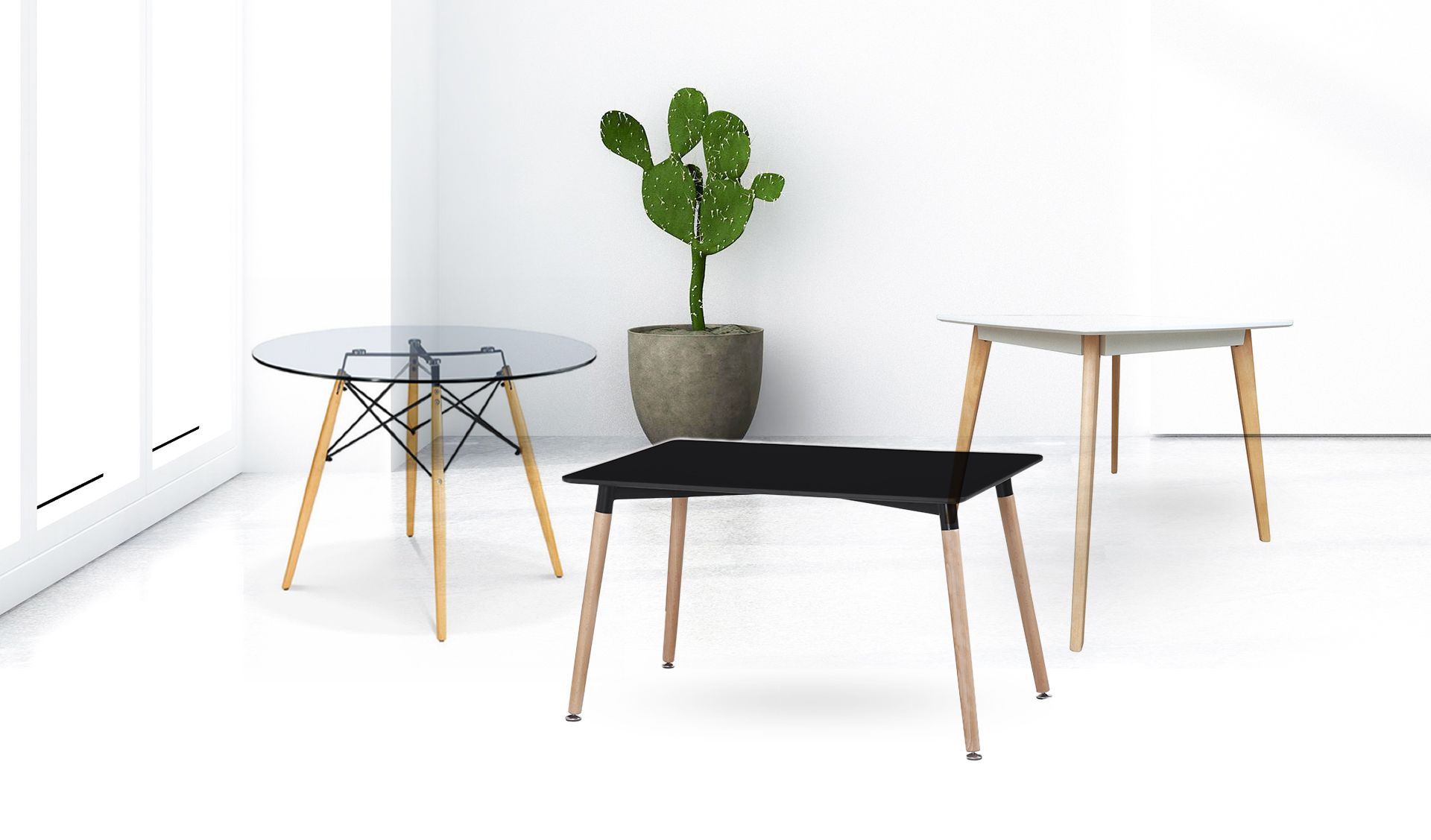
The display picture on this page shows three tables in one bright indoor scene, a round glass table, a black rectangular table and a white rectangular table, and it is captioned as a product display rather than as a furnished restaurant. That caption discipline matters for restaurant buyers, since a display picture shows tables without chairs, linen or guests, and a buyer who imagines a full dining room from it may misjudge scale. A sample table, viewed in the buyer's own room beside their chosen chairs, answers the scale question that no picture can.
Matching restaurant tables to restaurant chairs
A restaurant table and its chairs must agree on height, leg clearance and style, and the most common failure is a table whose legs leave no room for chairs at the ends, or whose apron presses against a tall diner's knees. Leg placement decides tucking, apron depth decides legroom, and base design decides whether chairs can slide in from every side. This site prints no table heights or apron depths, because the source pages do not verify them, so every matching question goes back to an inquiry where the buyer can name their chair line and ask about the table that suits it.
Style matching for restaurant tables follows the room's concept: a modern dining room suits clean MDF lines, a traditional room suits wood accents, and a bright cafe suits glass or white tops that keep the room feeling open. A buyer furnishing a whole restaurant should consider ordering tables and chairs together, so finishes can be matched in one production batch rather than across batches that may differ slightly. The restaurant furniture page develops that whole-room logic for buyers furnishing a restaurant rather than a single table.
Ordering restaurant tables for a dining room
A restaurant table inquiry should name the room, the floor plan or measurements, the table shape wanted and the chair line they will sit with, since those answers let the company recommend a shape and a quantity rather than a generic table. Material and finish come next, followed by any custom design, with the understanding that a dressed table needs a different finish conversation from an undressed one. A buyer ordering for a restaurant opening should name the opening date, since production must meet a day that cannot move.
Quantities, delivery timing and packing are settled per order, and a restaurant buyer should ask about ordering tables and chairs together, since a single delivery saves freight and lets finishes be matched. Ask how tables are packed to protect tops and edges, what happens if a top arrives marked, and whether single tables can be ordered later to match a set. Certificates for a specific model, where a buyer needs them, should be requested by model.