Why buyers choose plastic first
Plastic chairs win their first argument on cleaning: a PP seat wipes down between services, resists the stains that mark fabric, and keeps its colour through repeated washing in a busy room. They win their second argument on weight, since a light chair can be carried, stacked and reset by a small team, which matters for halls that change layout between events and for restaurants that reset between lunch and dinner. Their third argument is consistency, because a moulded seat repeats its shape and colour across hundreds of units in a way that a sewn seat cannot always match.
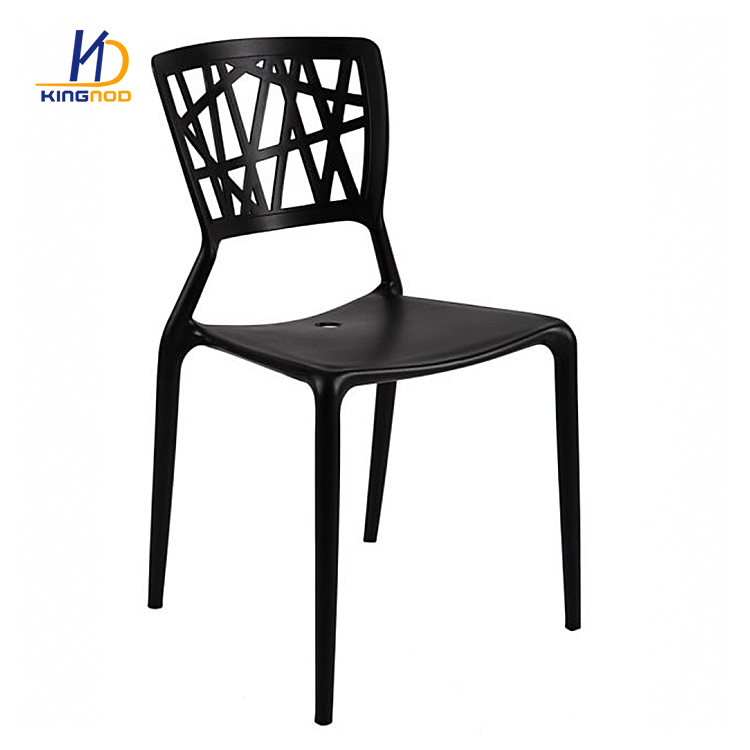
The verified model C-597 shows the plastic family at its most colourful: a multi-coloured PP dining chair for the living room, listed with its title quoted word for word, including the source spelling of its first word. That model belongs to the home use end of the plastic range, while the white plastic banquet chair and the black plastic chair with a pierced back belong to the commercial end, where wipe-clean performance and stacking matter more than colour variety. A buyer should decide which end of that spectrum their room sits at before choosing a plastic line.
PP, ABS and the material words buyers meet
The product FAQ names PP (Polypropylene) and ABS among the materials in use, and buyers meet those two words on many plastic chair listings. PP is the workhorse of this family: light, tough and easy to mould into dining chairs, banquet chairs and bar stools, with a surface that cleans quickly. ABS appears in moulded parts where a smooth, hard finish is wanted, and it suits components that must hold a precise shape across many units. Neither material needs a technical essay from the buyer, but knowing which one a chosen model uses helps when asking about cleaning, outdoor use and colour fastness.
Outdoor use deserves a direct question, because a plastic chair that thrives indoors may fade or stiffen in strong sun and cold, and the source pages do not give a weather rating for these lines. A buyer ordering plastic chairs for a garden, a terrace or a marquee should ask whether their chosen model suits outdoor use, how its colour holds in sunlight and whether it can be left outside between events. The garden chairs page carries that conversation further, with the red metal chair and the black plastic chair shown as single product photographs rather than as a set.
Stacking, storage and replacement
Plastic chairs stack, and that single fact shapes their whole ownership cost: a hall that can store three hundred chairs in a small room saves rent, labour and damage compared with a hall that must store the same number flat. Stacking also protects the finish, since chairs that nest cleanly do not rub each other in storage the way loose chairs do. A buyer should ask how a chosen model stacks, how high a safe stack runs and whether the seat surface marks when stacked, because those answers decide the storage room as much as the chair itself.
Replacement is the quiet advantage of a moulded plastic line: a single chair can usually be matched to a set ordered earlier, provided the model and colour stay in production. A buyer should ask whether a model is a continuing line or a limited run, and whether single chairs can be ordered as spares, since a restaurant that loses one chair from a set of forty needs a matching single, not a new set. Colour matching across batches is worth naming too, because a white that differs slightly between batches will show in a photograph of a full room.
Ordering plastic chairs in quantity
A plastic chair inquiry should name the room, the seat count and the colour, since those three answers let the company quote the right line without a long exchange. Custom colours can be raised in the same message, because the company supports customised colours, logos and designs, but a buyer should ask whether their chosen colour is available on plastic before assuming it, since a colour that works on fabric may not be offered on a moulded seat. A sample chair, checked under the room lighting and stacked with its neighbours, answers the colour and stacking questions faster than any swatch.
Delivery timing and packing for a plastic chair order depend on quantity and on whether models are mixed in one shipment, so the inquiry should ask whether different plastic lines can ship together and how chairs are packed for transit. A buyer ordering for a venue opening should name the opening date and ask whether production, including any sample step, can meet it. Certificates for a specific model, where a tender requires them, should be requested by model, and the certificates page explains why this site does not publish a blanket certificate list.