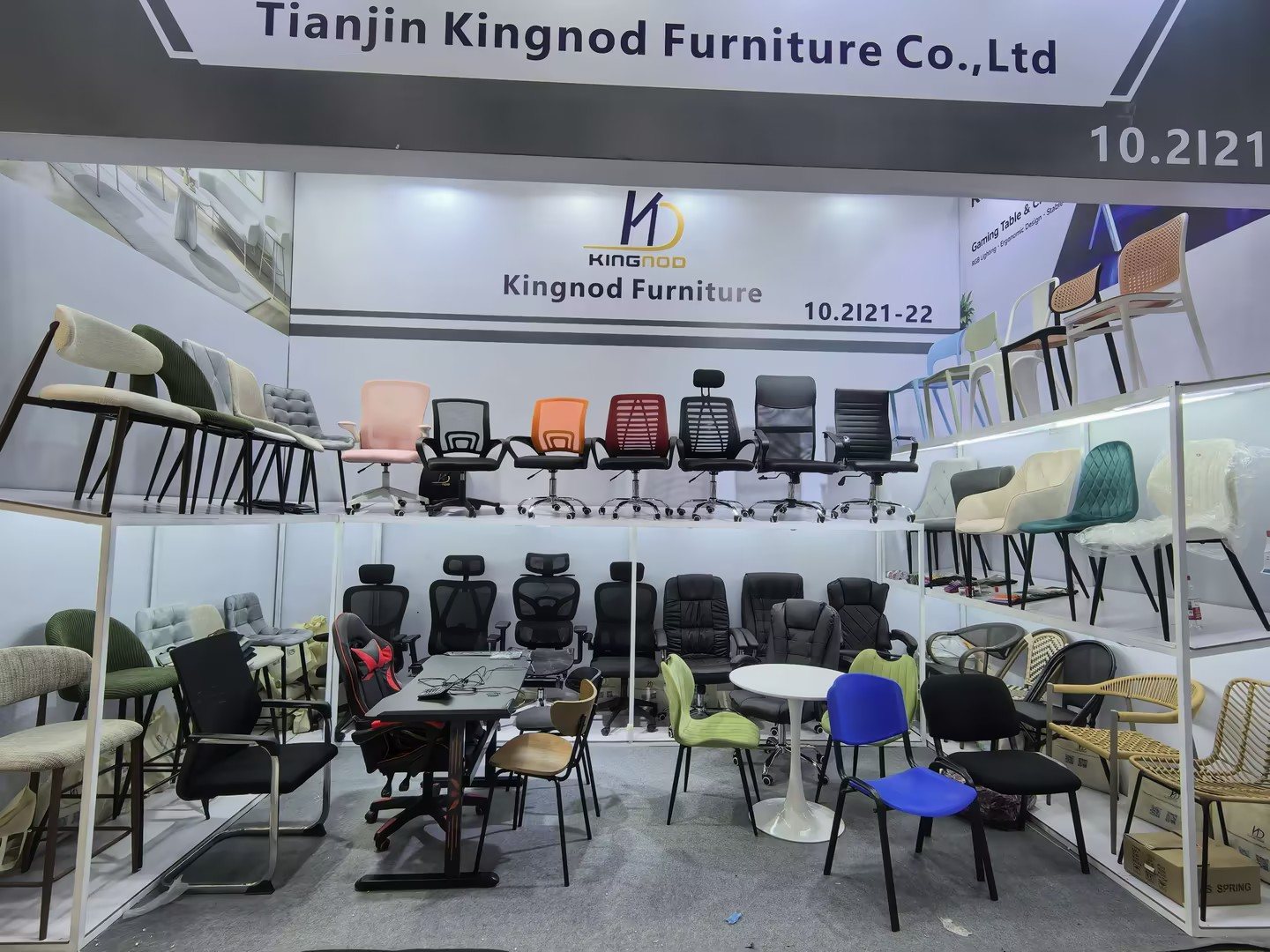
A chairs and tables supplier for rooms that seat people
A restaurant floor, a banquet hall, a bar counter and an office breakout area all ask for seating that can be wiped down, moved, stacked or rearranged without a second thought, and the Kingnod range is organised around those working rooms rather than around showpiece furniture. Restaurant chairs sit beside dining chairs in the catalogue because the same buyer often furnishes a dining room and a restaurant from one order, while office chairs and bar stools answer different postures, different floor plans and different wear patterns. Tables follow the same logic: a dining table, a banquet table, a bar table and a coffee table each carry a different rhythm of use, from a two-hour dinner service to a full-day conference with coffee breaks in between.
The company describes itself as a supplier of both home use and commercial furniture, and that dual footing matters when a buyer is choosing between a softer domestic look and a harder-wearing commercial finish. Home use lines lean on comfort and appearance for living rooms and dining rooms, while commercial lines lean on repeat use, cleaning and replacement of single pieces when one chair in a set of eighty wears out. A buyer who orders for a hotel, a restaurant group or a rental fleet is therefore looking at the same catalogue through a different lens from a buyer furnishing a single home, and the pages on this site separate those lenses wherever the source material allows it.
The chair and table lines buyers browse first
Restaurant chairs and dining chairs open the range, followed by banquet chairs for events and weddings, office chairs for workplaces, and bar stools for counters and high tables. Plastic chairs and metal chairs cut across those rooms by material, so a buyer who has already decided on a wipe-clean plastic seat or a metal frame can compare across settings without re-reading every room page. Upholstery chairs add a softer seat option for dining rooms and event spaces, while folding chairs and stackable banquet chairs answer storage: rooms that change layout between services need seating that can be put away quickly and brought back without damage.
Tables mirror the chairs. Dining tables anchor the dining room pages, coffee tables serve living rooms and lounges, banquet tables serve event halls, and bar tables and game tables serve leisure and hospitality corners. The seven individually verified models on this site, from a PP dining chair to a round MDF metal table, are presented as single examples with their listing titles quoted word for word, because the wider model catalogue has not been checked piece by piece. Everything else on this site stays at category level, which keeps the catalogue honest about what has actually been verified.
How an order conversation usually runs
An inquiry starts with the room and the seat count, then moves to the chair or table line, the material family and the finish the buyer has in mind. The company offers OEM and ODM work with customised colours, logos and designs, so a buyer who wants a house colour or a logo on a chair back can raise that in the first message rather than after a price has been discussed. A pre-production sample comes before mass production in the process the product pages describe, and a quality inspection takes place before shipment, which gives a buyer two natural checkpoints to ask about before goods leave the factory floor.
Documents travel with an order too: the product pages list a production process report, a quality report, a loading report and a bill of lading among the papers provided, alongside other documents a buyer may require. Delivery terms and payment methods differ from one product page to another, so this site does not publish a single house rule for either; the inquiry page asks buyers to settle the term and the payment route for their own line before money moves. That approach is slower than a one-line promise, but it matches the source pages, which genuinely differ from line to line.
Rooms and buyers this range speaks to
Restaurant and dining buyers form the largest audience for this catalogue, from independent restaurants fitting out a first dining room to groups refreshing several sites at once. Banquet and event buyers come next, often ordering in larger lots for halls that host weddings, conferences and celebrations, where stackable and matching chairs matter more than any single statement piece. Office buyers look for swivel and desk chairs that suit long working days, while bar buyers look for stools that fit a counter height they already have, which is why the bar stool guide on this site refuses to print height numbers and sends every height question back to an inquiry.
The slogan carried on the company pages, Customer is our king, reads as a service promise rather than a product claim, and the site treats it that way: it appears as a motto, not as evidence of a delivery record. Buyers who want proof of a specific capability, from a certificate to a loading report, are asked to request it in writing, and the certificates page explains that certificates are available upon request rather than listing documents nobody has shown.
Chairs and tables for hotels and venues
Hotels buy chairs and tables differently from restaurants, because a hotel must furnish a dining room, a lounge, a bar and a banquet hall that a guest moves between in a single stay, and a clash between any two of those rooms will be noticed. A hotel buyer should therefore consider the property as one order, even when the rooms are refurbished in phases, so that finishes, colours and chair lines can be coordinated across the whole property rather than chosen room by room. The commercial furniture page sets out that programme logic in full, and a hotel buyer should read it alongside the restaurant and banquet pages before sending an inquiry, since a hotel order that treats each room separately will cost more in mismatches than it saves in simplicity.
Venues that host weddings, conferences and celebrations face a similar whole-property question, since a hall that seats a wedding on Saturday and a conference on Monday needs seating that serves both without looking wrong at either. A venue buyer should ask whether one chair line can serve both event types, or whether a split fleet, with premium chairs for weddings and workhorse chairs for conferences, would serve better. That split decision, made before ordering, protects the premium chairs from conference wear and keeps the workhorse chairs out of wedding photographs, while a decision made after ordering will leave the venue with one fleet doing two jobs badly.
Starting an inquiry the right way
A good inquiry to this company opens with the room, the seat count and the line, because those three facts let the company answer about a real order rather than about a catalogue in general. A buyer who opens with a vague request for a price list will receive a general answer, while a buyer who opens with a room, a count and a model code will receive a specific one, and the difference between those two answers is the difference between a conversation and a catalogue. Custom colours, logos and designs belong in that opening message too, since a custom finish changes the sample, the production and the timing, and a buyer who raises customisation late may discover that production has already begun on a standard finish.
A good inquiry also names its date, since a restaurant opening, a hotel refurbishment and a wedding cannot move, and a company that knows the date can say plainly whether production, including any sample step, can meet it. A buyer who hides the date until late in the conversation risks a delivery that arrives after the event it was bought for, which is the most expensive failure in furniture ordering. Naming the date early, together with the room, the count and the line, turns an inquiry from a request for information into a plan for delivery, and this site is built to push buyers toward that plan on every page.
How to use this site without being misled by it
This site is organised so that a buyer can move from a room to a material to a model without ever meeting a figure the sources do not support, and that organisation is worth understanding before browsing. Category pages describe families, product pages describe single verified models with their listing titles quoted word for word, and guide pages explain decisions without inventing the figures a decision would normally need. A buyer who understands that structure will know when to read a category page for breadth, when to read a product page for a specific model, and when to stop reading and send an inquiry, which is the point at which this site has done its job.
The site also leaves gaps visible rather than filling them: no prices, no single delivery term, no certificate list, no height chart and no street address appear anywhere here, because the sources do not support any of them. A buyer who meets a furniture site that fills every gap with a confident figure should ask where that figure came from, since a confident figure without a source is a guess dressed as a fact. This site would rather leave a gap and send the buyer to an inquiry than fill it with a guess, and buyers should hold every furniture site, including this one, to that standard.
Prices, terms and figures on this site
No price appears anywhere on this site, and that absence is worth explaining rather than apologising for, since a price without a model, a quantity and a finish is not a price at all but a number waiting to be misunderstood. The source pages give no verified price list, and a price invented to fill the gap would mislead every buyer who planned a budget around it. A buyer who needs a price should therefore name a model, a quantity and a finish in an inquiry, and should treat any price quoted without those three anchors as provisional, since a price that ignores quantity and finish cannot survive contact with production.
The same logic governs delivery terms, payment routes and document lists on this site: each differs between product pages, so each is settled per order rather than printed as a house rule. A buyer who reads this site should expect to settle those four items, price, term, payment and documents, in the inquiry for their own line, and should be wary of any furniture site that prints a single house rule for all of them without naming its sources. That wariness is not cynicism; it is the habit of a buyer who has learned that furniture ordering rewards specific questions and punishes general assurances.
Browsing this catalogue in a sensible order
A buyer new to this catalogue will browse most efficiently by starting with a room page, then a material page, then a model page, since that order moves from the general to the specific without wasting time on lines the room does not need. A restaurant buyer, for example, might start with the restaurant chair page, narrow to plastic or metal chairs by cleaning needs, and then look at a verified model such as C-496 or C-486 for a concrete example. A bar buyer might start with the bar stool page, read the height guide, and then look at an adjustable stool page, since height decides a bar order before material does.
Guide pages reward a different kind of reading, since they answer decisions rather than describing products, and a buyer who reads a guide before browsing models will choose faster. The restaurant chair buying guide sets out the room-to-order sequence, the plastic versus metal comparison sets out the material choice, and the bar stool height guide sets out the measurement method, and together those three guides cover the decisions most buyers actually struggle with. A buyer who reads the relevant guide first, then browses models with a decision already half made, will send a sharper inquiry than a buyer who browses models first and discovers the decision afterwards.
A final browsing habit is worth forming early: keep the inquiry page open beside the catalogue, and note the questions each page raises as they arise, since a question noted in the moment is a question that reaches the company, while a question left to memory is often lost by the time an order is placed. A buyer who collects those questions page by page will arrive at the inquiry form with a list that covers room, material, model, colour, quantity, timing and documents together, and that list is the closest thing this catalogue offers to a complete order brief.